
80s
10 Years Of Premam: The Love Story That Changed Malayalam Cinema_我的网站

A |
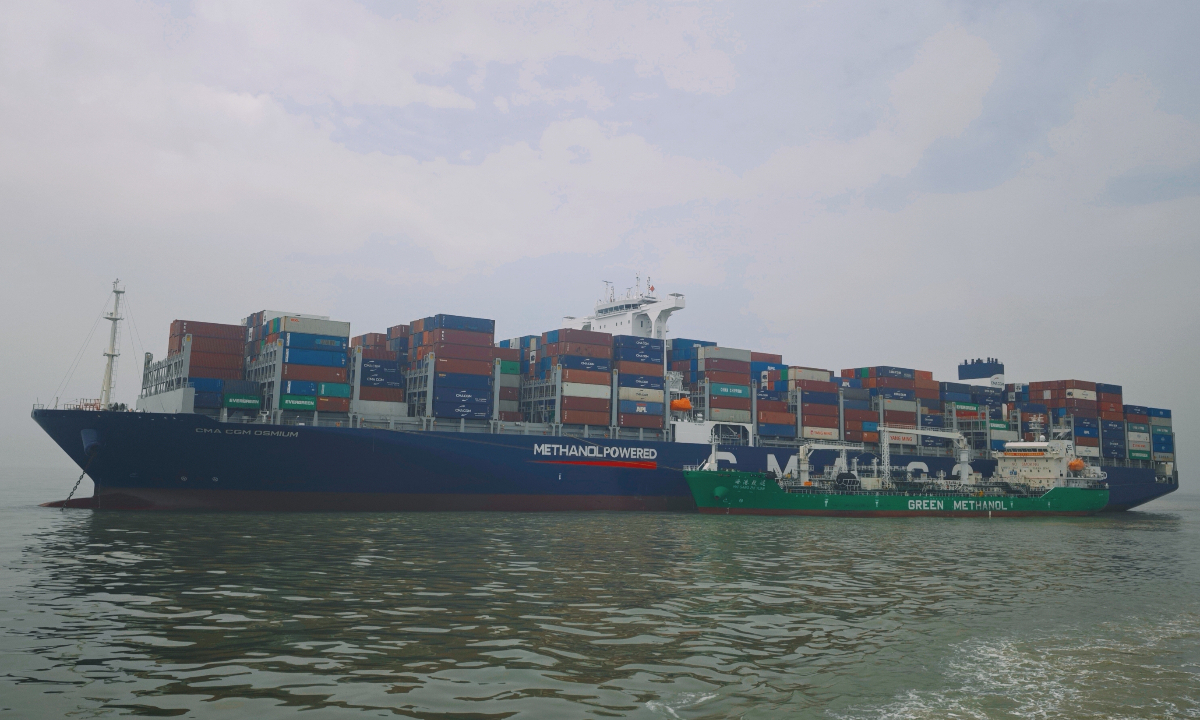
Shanghai Port has for the first time successfully completed simultaneously the bunkering of two types of green fuel for two international vessels at the offshore anchorage, marking a milestone in the port’s ability to provide diversified and large-scale marine fuel supplies, chinanews.com reported on Sunday.
Haigang Zhiyuan, a methanol bunkering vessel, successfully completed the bunkering of domestic-produced biomethanol to methanol-powered containership CMA CGM Osmium, which flies the Maltese flag, while Haigang Weilai, a liquefied natural gas (LNG) bunkering vessel, successfully completed the bunkering of LNG to Kota Elan, a Singapore-flagged dual-fuel LNG container ship at the Lühuashan Anchorage off Shanghai from Saturday to Sunday.
Most of the biomethanol supplied in the bunkering operation was produced by Shanghai Electric’s Taonan project. Which means the methanol feedstock was transported by land from Taonan, in Northeast China’s Jilin Province, to Dalian Port in Northeast China’s Liaoning Province, then shipped by sea to storage tanks in Shanghai, before being used for vessel bunkering at Shanghai Port. This established a cross-regional supply chain linking production in Jilin, transshipment in Dalian and bunkering in Shanghai, said the report.
The cross-provincial supply chain from Northeast China to Shanghai expands the market for domestic biomethanol and highlights progress in building a north-to-south green fuel transportation corridor, according to the report.

According to the Yangshan Border Inspection Station, the two vessels receiving the bunkering service have different sailing schedules. the CMA CGM Osmium is en route from Qingdao in Shandong Province to Ningbo in Zhejiang Province via Shanghai, while the newly built Kota Elan will conduct sea trials after bunkering.
Completing clean-fuel bunkering at an anchorage cuts berth, tugboat and pilotage costs, and reduces vessel waiting times, which lowers the energy replenishment costs for international vessels and strengthens Shanghai Port’s overall competitiveness as a shipping hub, chinanews.com reported.
Global Times
。 When Alphonse Puthren’s Premam hit theatres on May 29, 2015, few could have predicted the tidal wave it would unleash. A film that eschewed conventional romantic tropes in favour of raw, organic storytelling, Premam captured the hearts of Malayali audiences and quickly spilled over into pan-Indian pop culture. It wasn’t just a film, it was a phenomenon. A Genre Reimagined—How Premam Redefined Romance for a Generation Told in three acts, each representing a phase of George’s (Nivin Pauly) romantic life, Premam took a structurally bold approach to love on screen. It was a coming-of-age tale, but one that resisted the overwrought drama typical of love stories. Instead, it focused on the small, fleeting details; the glances, silences, heartbreaks, and awkwardness of youth. That made it more relatable. More significantly, it brought about a tonal shift in Malayalam romantic cinema. This was no longer about larger-than-life lovers, but ordinary people in everyday situations. In many ways, Premam reintroduced a kind of emotional minimalism that would later echo through countless films, from Aanandam to Hridayam. Technical Craft and Iconic Performances—A Film That Felt Like a Vibe Technically, Premam was a masterclass in seamless storytelling. Anend C. Chandran’s cinematography glowed with warmth and nostalgia, his frames capturing Fort Kochi and other locales with a lyrical intimacy. Rajesh Murugesan’s soundtrack was integral, not supplementary to the narrative, with songs like Aluva Puzha and Malare becoming generational anthems. In fact, the film’s sonic texture did more than enhance mood; it drove emotional beats in the absence of heavy dialogue. The editing, also by Alphonse Puthren, gave Premam its rhythm: casual, unhurried, and honest. There were no sharp tonal shifts, only fluid transitions from laughter to heartbreak. It reflected a new cinematic language, one that embraced pauses and imperfections. Performances too were career-defining. Nivin Pauly shed his boy-next-door skin to become a poster child for youthful vulnerability. Sai Pallavi’s debut as Malar was magnetic and effortlessly graceful, with the kind of quiet intensity that made her an overnight star. Madonna Sebastian and Anupama Parameswaran completed the trio of memorable women, each nuanced and never written as just love interests. They had agency, identity, and arcs of their own. Legacy and Imitations—Why No One Could Replicate Premam Over the years, Premam inspired an entire wave of soft romances and youthful dramas across industries. Yet, none could replicate its magic. Even the Telugu remake, though commercially successful, lacked the understated soul of the original. What set Premam apart was its authenticity. It never tried to preach or stylise love; it just let it exist. View this post on Instagram A post shared by Nivin Pauly (@nivinpaulyactor) Culturally, Premam became a visual and sartorial blueprint. From Nivin’s beard to Sai Pallavi’s half-sari look and chalk-dusting classroom entry, every frame became a mood board. Its dialogues became memes, its characters icons, and its music a staple of college playlists. More importantly, it changed how a generation viewed love. Not as conquest, but as growth. See Also: Premam director Alphonse Puthren says Kamal Hassan should be made Tamil Nadu CM。
Current article:http://ee3yz.pisezuibanzoukou.cyou/list_bgeq4/e1dphr.html
Published on:00:00:00