
英雄少年
8.86秒轻松超越博尔特!人形机器人百米竞速再次刷新纪录_我的网站

A |
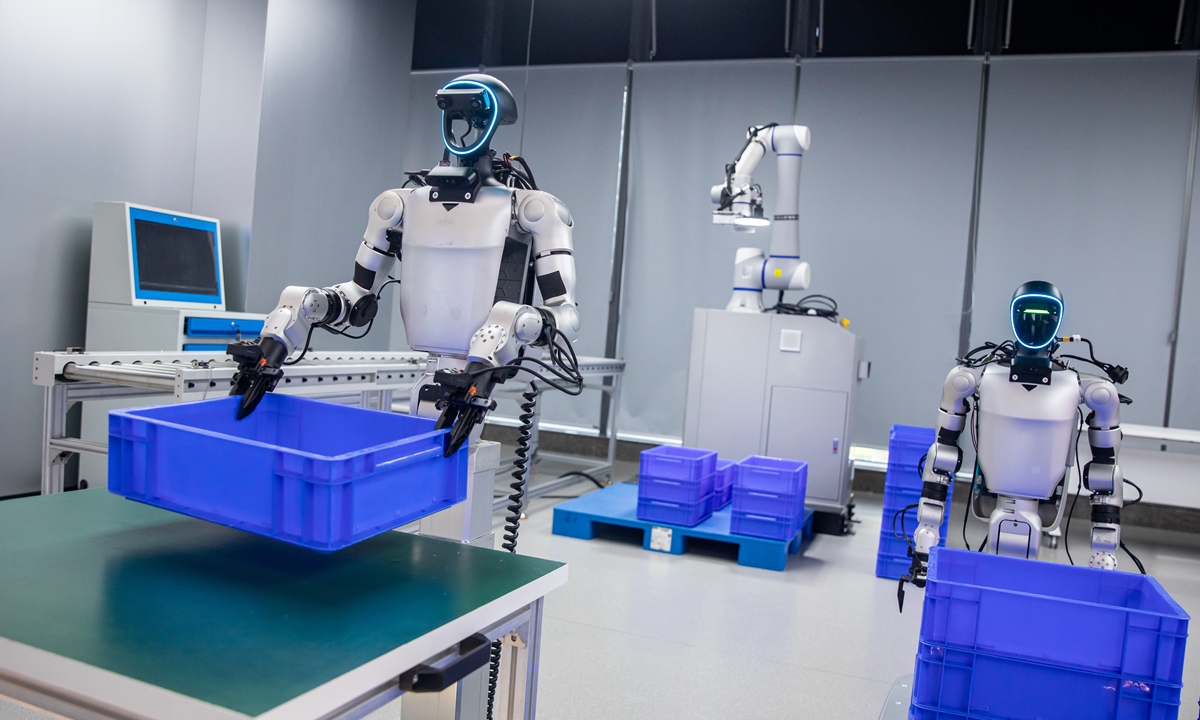
Consumer-oriented embodied AI model developer Noin Intelligence announced a 500-million-yuan ($74.1 million) Angel++ funding round on Monday, the company said in a statement, marking another major capital inflow into embodied AI models as investors turn their attention toward the "brains" behind robots.
According to the statement, the company plans to channel the funding into developing more generalizable embodied AI models, advancing iterations of its GLOW generative model, and accelerating product validation and mass production.
Industry experts noted that a broader shift in the robotics race, with competition moving beyond hardware performance toward the development of core intelligence capabilities. While hardware forms the physical foundation of robots, embodied AI models determine their ability to perceive, learn, reason and adapt in real-world environments, making them a key factor in unlocking future opportunities.
The funding momentum extends beyond Noin Intelligence, with several other companies recently securing major financing rounds that are largely focused on advancing their AI models.
On August 3, Wuxi-based embodied intelligence company DISCOVER Robotics secured a $100 million Angel+ funding round, shortly after completing its initial angel financing of more than $100 million, according to Wuxi Fabu, the official WeChat account of the local government.
The company later introduced ORION, a hierarchical embodied intelligence foundation model, as well as LOOP, a virtual-real hybrid data closed-loop system, and DISCOVERSE, a high-fidelity simulator. The solutions are designed to tackle two major challenges facing the embodied intelligence — data scarcity and limited generalization — and accelerate the development of more capable AI systems, according to Wuxi Fabu.
In addition, according to industry media reports on August 3, Ant Lingbo, Ant Group's embodied intelligence subsidiary, has launched its first round of financing, seeking to raise 1.5 billion yuan.
The company aims to complete a second funding round by the end of this year. The company later confirmed to media that it was in discussions with investors, saying that as a core initiative of Ant Group's embodied intelligence strategy, it will continue to focus on developing general-purpose robotic brains, increase investment in embodied-native technology pathways, and accelerate industrial deployment.
The shift is also reflected in the fundraising priorities of publicly listed candidates.
Notably, Unitree Robotics, which has recently drawn widespread attention from the capital market, officially opened IPO subscriptions on Monday. According to its prospectus registration document disclosed by the Shanghai Stock Exchange on June 2, the company plans to raise 4.202 billion yuan through the IPO, with nearly half of the proceeds earmarked for its intelligent robot model R&D project.
Of the total proceeds, 2.02 billion yuan will be allocated to the intelligent robot model development project, significantly exceeding the 1.11 billion yuan planned for robot body R&D, highlighting the company's focus on developing the AI capabilities that power robots.
Wang Peng, an associate research fellow at the Beijing Academy of Social Sciences, said the latest financing trend shows that capital is reassessing where the core value of robotics lies. Investors are increasingly moving beyond robot hardware itself and treating embodied AI models and robotic "brains" as high-value assets, with capital flowing more toward software, algorithms and intelligence capabilities, he told the Global Times on Monday.
The valuation framework is also being reshaped, with investors paying greater attention to real-world deployment, customer adoption and repeat demand rather than hardware specifications or corporate narratives alone. Whether robots can operate reliably in real application scenarios has become a key benchmark for investment decisions, Wang said.
He added that increased investment in embodied AI models and generative world models could help address the structural gap between general-purpose AI models and physical-world interaction by expanding the supply of real-world interaction data. Capital is also increasingly favoring companies aligned with the country's long-term industrial priorities and emerging industry development plans, he said.
According to data from IT industry research platform ITjuzi.com, financing in China's embodied intelligence sector totaled 93.5 billion yuan in the first half of 2026, surpassing 90 billion yuan and marking a fivefold increase from the same period in 2025. The number of financing deals reached 322, up 137 percent year-on-year.
As China enters the first year of its 15th Five-Year Plan period (2026-30), policy priorities are placing greater emphasis on developing emerging industries, with the country accelerating AI development and promoting its integration with various sectors, Chinese experts noted. Meanwhile, as global AI development enters a new stage driven by broader applications and deeper industry integration, embodied intelligence is expected to unlock significant growth potential.
Driven by policy support and rapid industry evolution, the nation's upstream and downstream segments of the AI industry have gained momentum, achieving notable progress.
According to a Bloomberg's Monday report, China's humanoid robot makers commanded more than 97 percent of global shipments in the first half of 2026, according to new industry data affirming the country's early lead against US rivals in the burgeoning field.
Meanwhile, global humanoid robot shipments totaled roughly 19,100 units in the first half of 2026, more than triple the 5,100 units shipped in the same period last year, according to data from Smart Analytics Global. Data further noted the California-based research firm expects shipments to rise to around 60,000 units this year and reach half a million by 2030.
。 8月26日消息,昨晚,第二届世界人形机器人运动会大型组100米复赛在北京国家速滑馆进行。 本轮复赛竞争异常激烈,荣耀“闪电”机器人率先跑出8.94秒,刷新赛会百米竞速纪录;紧随其后的是来自北京人形机器人创新中心的天工Ultra,更是跑出8.86秒的成绩,再度刷新该赛事人形机器人百米竞速纪录。 在此前开幕式预赛中,这款机器人就已经跑出9.39秒,超越博尔特9.58秒的人类男子百米世界纪录;复赛阶段再度把成绩大幅压缩至8.86秒,较人类百米世界纪录快0.72秒。 百米冲刺非常考验人形机器人的综合能力,需要完成快速启动、极限加速,全程高速下维持躯体平衡,对电机响应速度、整机动力学算法、姿态控制都是极高考验。

B | 资料显示,天工Ultra是北京人形机器人创新中心开发的全尺寸高性能人形机器人,属于天工系列的竞速耐力强化版本,是国内运动性能顶尖的双足人形机器人。 身高1.8米,体重55kg,体型接近成年男性,搭载大功率一体化伺服关节,配备六维力传感器、IMU惯性单元、3D视觉感知模块,具备力反馈与姿态感知能力。 同时还搭载“慧思开物”具身智能平台,依靠强化学习运动算法实现高速奔跑与抗干扰平衡,并支持电池快换,满足长距离连续运行需求。 值得一提的是,它还是全球首台完成半程马拉松的人形机器人:去年4月北京亦庄半马,用时2小时40分42秒跑完21.0975公里,全程自主运行,创造世界纪录。

C | 除了刷新人形机器人百米竞速最好成绩外,天工Ultra在本届赛事上还创下了另外两项世界纪录: 400米大型组决赛,跑出38.15秒夺得金牌,大幅领先超过人类(43.03秒);开幕式原地跳高展示,跳出2.8843米,高于人类原地跳高2.45米的最好成绩。
【本文结束】如需转载请务必注明出处:
责任编辑:落木
文章内容举报
。Current article:http://ee3yz.pisezuibanzoukou.cyou/list_mvsaa/xrem73k.html
Published on:00:00:00
我的网站最近更新
- 免费游玩日:Train Sim World 6: Standard Edition、Icarus: Console Edition 和 Lynked: Banner of the Spark
- 27年前帮中国治沙造林的“赛考斯”,今天回来了
- 重要会议透露的5个线索
- 易景通景区票务系统透明报价:让甲方看清每一项投入
- 国台办赞赏马来西亚一中原则立场
- 国网抚顺供电公司:积极应对雨雪冰冻天气 全力保障电网稳定运行
- California Governor Newsom is Running Ads in Florida: ‘Join Us In California’
- 女足天才少女张琳艳即将“留洋”欧洲联赛 父亲:多学技术经验,这是一种历练
- 祥乾资产|沪指弱势震荡跌0.8%,金融、酿酒等板块下挫_钱银_经济
- Police Respond to False Report at Residence Where Ex-Trump Adviser Bannon Reportedly Lives
- 这一次,全世界打脸以色列,也狠狠打脸美国
- 高龄跑者,中签难,到底有什么“隐情”?
- Study: United States - Mexico Border Now the Most Dangerous Land Crossing in the World
- 中方最高层五年没去欧洲,这次出访塞尔维亚等三国,释放明确信号
- 孙雯:中国女足面临诸多挑战 希望球迷长久陪伴
- 萌宝出击,快乐第一——深圳市滨苑幼儿园(龙华)小一班晨会
- 深圳市福田区调整部分区域风险等级
- 重庆市财政局:以严谨科学制度安排确保长护险基金收支平衡、运行平稳
- China-made humanoid robots are rapidly moving out of labs into real-world industries: FM
- 'China Is Awesome': Elon Musk recommends visiting China
- 多部门推出活跃县域消费十八条举措——激发县域市场消费潜力
- 电力概念异动拉升,新中港涨停
- 人民日报钟才文:推动高质量发展行稳致远
- 安踏集团:上半年收入同比增长12.9%至435.1亿元
我的网站热门资讯
- 存储短缺导致平板显示器市场下滑
- 美迪凯:股东翁钦盛和矢岛大和合计减持5万股公司股份,减持计划实施完毕
- 熊猫推出“F32Q5”31.5 英寸显示器:2K 165Hz HVA 面板,999 元
- 7400万变底薪!总冠军,他来了
- 羊了个羊被质疑抄袭,公司仅7人参保_《羊了个羊》被曝疑抄袭《3tiles》_简游
- A股42家上市银行唯一 重庆银行凭什么?
- 过去十年最大转会利润俱乐部排名(不含青训):里尔4.36亿欧居首
- 国际识局:日本福岛第六批核污染水排放!东电被曝多次违规操作
- 让这份文化遗产成为读懂中国式现代化的一扇窗口
- Bollywood Celebs Spread Christmas Cheer With Cosy Posts and Smiles
- AMD旗舰RX 10800 XT太夸张!12800流处理器+48GB显存:远超RTX 5090
- 女子55元捡漏1.41万梵克雅宝项链,工作人员称系平台bug,女子接受补偿5元:同为打工人,非常理解
- Practitioners’ Insights: How did a decade of dedicated effort build China a self-reliant ‘digital track’?
- 世界艾滋病日丨艾滋病防治宣传教育知识!
- 研究人员一种更容易和更安全合成药物的方法
- 主动投案,贵州威宁自治县第三中学退休教师肖宁接受监察调查
- 券商行业又迎大规模配股!中金公司抛270亿元募资计划_业务_募集资金
- 【漫画】セルフ給油中、予想外の事態に「子どもを降ろさなくてよかった…」 1.6万人がゾッ!「これは焦る」【作者取材】
- 国内品牌金饰克价重回1400元
- 西亚卡姆若空降76人,勒布朗+恩比德+布朗三巨头再添猛将?
- 車椅子で運ばれた吉田響 「低血糖と脱水で目眩」と後半の症状説明 「最高の大阪マラソン」と感謝の思いつづる
- 産まれてすぐ看護師に「シュッとしててイケメン」と言われた息子。しかし、2年後の姿に「あれ?笑」「諦めないで!!」「珍しいパターン」
- 爱在枪火中重燃《全球使命3》七夕淘礼嗨不停
- 【圣淘沙名胜世界&TEAM WANG design】 联手打造新加坡环球影城万圣节惊魂夜12鬼屋